“It is not enough to do your best; you must know what to do, and then do your best.”
W. Edwards Deming
The role of a Technical Lead can be broad. What needs doing varies from team to team, project to project. A great Tech Lead is resourceful, with a wide skill set to pull from. We need to be well-rounded to meet this challenge.
The Well-Rounded Tech Lead model is built to guide to us; to help grow ourselves to meet this demand.
What I mean by ‘Tech Lead’
A Tech Lead takes responsibility for a technical delivery. They’re not alone though. Their job is to share the responsibility with a team of engineers and other skilled practitioners. Solving a business problem together, through technologies and software.
A Tech Lead may guide, lead, or facilitate the direction for the group. Sharing the responsibility and ownership out in balance with the group’s needs and capabilities. It’s still in a ‘doing’ role though – remaining great at being able to get stuff done, and helping others do the same.
But being an ace technician is not enough. The needs of most teams are wider that that. Depending on the situation and ability of the team, the Tech Lead may be removing impediments, mentoring or coaching. They’re likely to be coding, though not as much as they’d like to be. It’s not their main job any more. What they will be doing is helping the team explore the solution though code, design, metaphor, and automation.
There often will be an need for focus beyond the team and the current work. Collaborating with leaders in different disciplines to set and plan against objectives needed to meet the business goals. In this situation there’s often a need to explore less-developed skills, and to grow in directions not explored as an engineer.
“Funny, I don’t call them that.”
Some people talk about Technical Team Leaders, others Lead Programmers. I see these as playing similar roles, I’m okay if you call them something different, if you’ll forgive me for my naming in return.
In the mix are often Architects, Staff Engineers, and Iteration / Delivery Managers. I see these roles as separate to that of a Tech Lead, though sometimes the Lead and their team do play part of these roles. These roles become more discrete in larger organisations and groups, with the need for increased co-ordination.
Having a definition is important
Having a rich definition is valuable to progression and learning. It’s crucial to know what good looks like, if you want to grow to be good. Definitions and models allow you to reflect, assess, and make plans. They can challenge our status quo and provide a different perspective.
However, experiences are far more valuable than introspection. Any model is a check and balance to your own experiences. Use them to help you expand and explore, ask others about their experience and mix it all in.
A caveat: It doesn’t have to be mine
This is just a model – a slice through the continuum that is leadership. Don’t stress if it doesn’t match yours – that’s where some of the best conversations start. Every leader comes from different roots and has a different focus and style.
A walk around the model
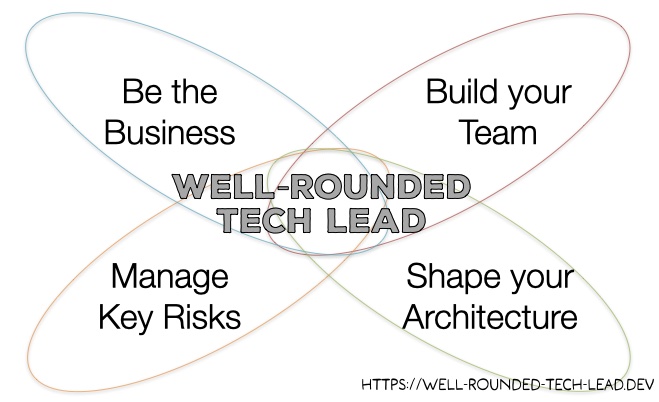
The Well Rounded Tech Lead model has 4 wings. Each of them essential. These areas are broad, it should be easy to look at each area and specify the expectations of your job. I have a view of what important activities I place in each quadrant – I’ll be working though more details of each in following posts.
Build your team
A good place to begin is towards the team that you are there to support and guide. All teams needs clarity and safety to get to the flow state that can predictably produce valuable results. A focus here can reap rewards.
New tech leads need to shift their focus from being a brilliant Individual Contributor. You are working with a team to scale up what you do well, but you need to learn how to help a team do well.
You may need to be a role model, a guide, or to add the structure and vision to allow a set of great engineers be great together. You’ll need to think strategically too, setting direction where there complexity and complication, and help the team build and learn in small steps.
Shape your Architecture
You and the team are here to build something useful out of code and technologies. This is complex work. Rarely will it be obvious what the right answers are when you start, or even what order to ask the questions in. You’ll need to ensure that the team has a vision of how and what to build and a way to learn and adjust on the way. You’ll also need to be working with the larger engineering org. Finding who will be partners or consumers, and who can provide support or paved paths.
As a new Tech Lead, it’s easy to get lost in the deadlines and begin a race to the finish too soon, or to build something that functions but doesn’t work when the pressure’s on. You’ll need to step back and assess what’s important, what your team can do, what your organisation can offer you and what’s going to be the big challenge.
Manage Key Risks
Building new technology is fraught with risk. Being late to market can be as risky as being early and unscaled. Things can look like they are working, until they don’t. You might be experimenting with a product, looking for market-fit, or scaling a subsystem so you can scale. Perhaps you’ll be doing both at the same time.
A Tech Lead will need to work to manage the technical risks and debt, and helping run and adapt a delivery plan as build happens. Spotting stale choices, managing debt and balancing trade-offs.
Once your product is in your users’ hands the trade-offs can become more complex. The Tech Lead will need to be collaborating with folk outside the team and outside engineering to steer well
Be the business
Products aren’t assembled in a vacuum. Software is built for a purpose. No matter the size of the org you work in, there’ll be a group of folks that use available information to pick direction, gather funding and make plans to deliver value. You are their trusted boots on the ground and that is often a new part of the job.
You will be likely to be surfacing what’s emerged as challenging, what the team has decided to do about it and what guidance is needed. You will likely be in conversations that guide choices that involve technology. Both what the team owns and sometimes a broader view. This can be in steering sessions or in production incidents, where swift decisions need to be made.
Grow your focus
You don’t have to do it all at once
Not every job requires all these skills and insights. As demand changes; the more a Tech Lead works in varied environments and as they progress to larger challenges, its likely that they will be pulling from each of the quadrants to do their job.
Ask: were might I go?
If you are looking to grow as Tech Lead, take some time to look at the model, and consider what spaces you fill and what spaces you can see value in expanding. And then ask: how can I grow to meet those new needs?
 The Well Rounded Tech Lead
Leave a comment